
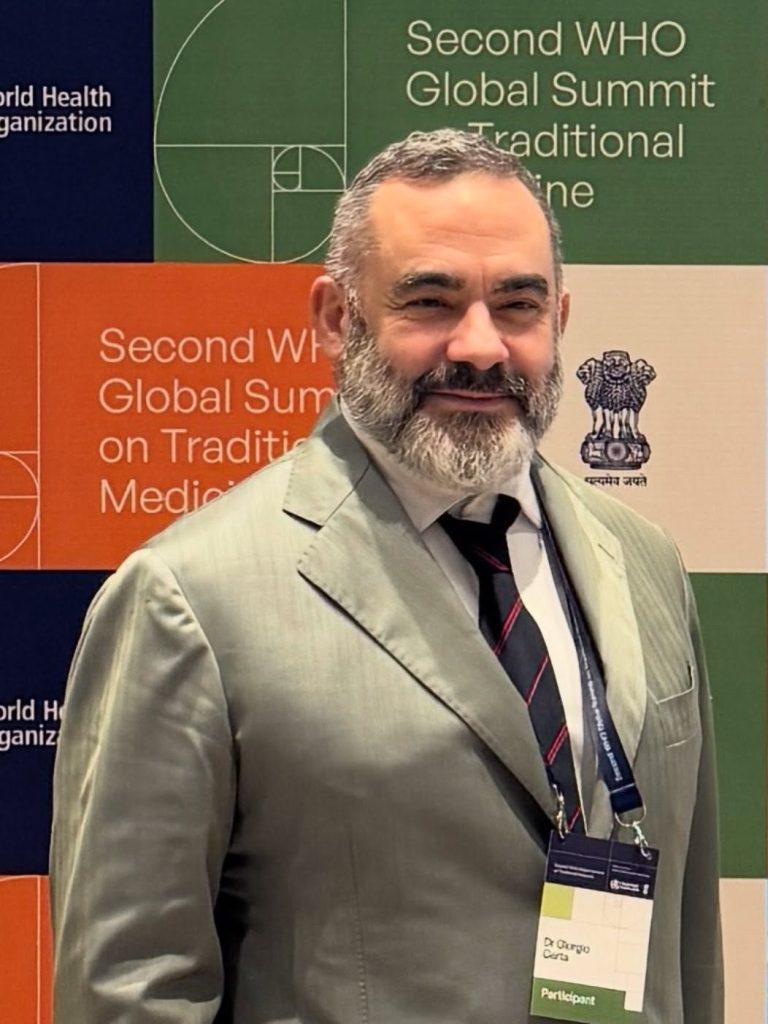
New Delhi – The future of global medicine speaks a language that unites ancient wisdom and technological innovation. On December 22nd, the second World Health Organization (WHO) Global Summit on Traditional Medicine concluded in New Delhi, a historic event that saw the participation of over 800 delegates from 100 countries and 16,000 participants connected from all over the world.
In this high-profile scientific and institutional context, Italy found an authoritative voice in Dr. Giorgio Carta, who attended as a speaker. His presence at the Summit underscores the growing importance that the international medical landscape attributes to the integration of different therapeutic approaches, provided they are guided by scientific rigor and clinical safety.
A Summit to Redefine Global Healthcare
The Summit, organized jointly by the WHO and the Indian Government, marked the official launch of the Global Strategy for Traditional Medicine 2025-2034. The goal is ambitious: to transform traditional, complementary, and integrative medicine (TCIM) from a parallel system into a fundamental pillar of national health systems to achieve universal health coverage.
During the working sessions, Dr. Giorgio Carta offered his technical-scientific contribution, actively participating in the debate on the need to standardize practices and enhance evidence-based research. In his speech, Dr. Carta highlighted how a person-centered approach—typical of many medical traditions—can be the key to addressing the great challenges of modernity, from non-communicable diseases to an aging population.
Dr. Giorgio Carta’s Contribution: Evidence-Based Integration
Dr. Carta remarked on a crucial point of the Summit: the transition from simple recognition of traditional medicine to the generation of tangible results. “The challenge is not only to preserve ancient knowledge but to validate it through the tools of modern science,” he reaffirmed during the proceedings.
His report touched on cutting-edge themes, such as the interoperability of health data and the importance of creating monitoring systems to evaluate the effectiveness of integrated therapies. In a world where patients increasingly seek a holistic and personalized approach, Dr. Carta’s contribution provided essential insights into how doctors can lead this transition without sacrificing the pillars of safety and regulation.
Global Innovations and Commitments
The New Delhi summit was not just a moment for theoretical discussion, but the cradle of revolutionary initiatives. Indeed, the Traditional Medicine Global Library was presented—a digital platform collecting over 1.6 million scientific resources, powered by a dedicated artificial intelligence (TMGL GPT) to accelerate global research.
Furthermore, the launch of the Health & Heritage Innovations (H2I) initiative highlighted the WHO’s desire to fund startups and projects that use genomics and digital technology to enhance traditional care. Dr. Carta participated in technical discussions on these new tools, emphasizing how AI can help bridge the evidence gaps that still exist in many sectors of integrated medicine.
The Delhi Declaration and the Future
The Summit concluded with the adoption of the Delhi Declaration, a solemn commitment signed by numerous Member States to invest in research, strengthen regulations, and integrate traditional medicine into primary care.
The Director-General of the WHO, Dr. Tedros Adhanom Ghebreyesus, stated: “Traditional medicine can help support care that is culturally rooted and holistic.” This is a message that resonates perfectly with the vision brought by Dr. Giorgio Carta to New Delhi: a medicine that does not forget its roots but looks to the future with rigor, ethics, and a spirit of innovation.
Dr. Carta’s participation as a speaker at this world summit represents not only a professional milestone but an important signal for the medical community: the era of integrated, safe, and accessible medicine for everyone has finally begun.